
A disciplined ASIC miner maintenance program treats every machine as a serialized asset with a documented failure history, a defined spares policy, and a warranty-safe repair path, because that structure recovers more hashrate per technician hour than any cleaning checklist alone. At fleet scale, the difference between a well-run operation and a struggling one shows up in how fast a fault is classified, how often the right part is already on the shelf, and whether the evidence package survives a manufacturer review.
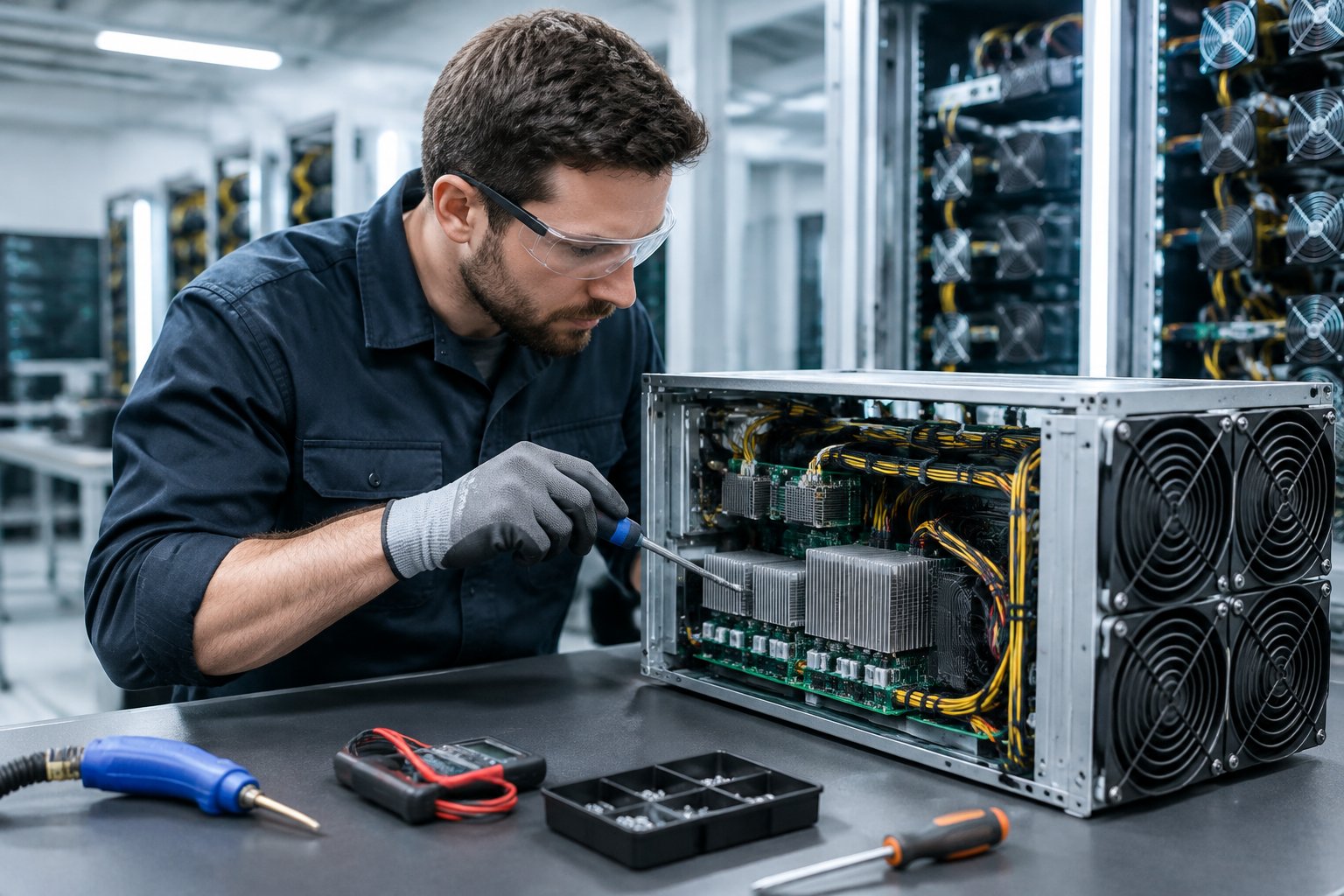
ASIC fleet maintenance is essential for reducing downtime, controlling repair costs and maintaining reliable mining operations.
Mining hardware fails in patterns. Hashboards lose chips, power supplies drift out of spec, fan bearings wear, control boards corrupt, and thermal interface material dries out. Each of those failure modes has a different diagnostic signature, a different spare-part lead time, and a different effect on power consumption and hashrate. Operations that record those differences at the serial level build a demand history they can plan against. Operations that do not end up guessing, swapping good parts into bad machines, and burning warranty eligibility in the process.
The economics are direct. A machine that hashes 10% below its rated output earns roughly 10% less bitcoin while drawing the same electricity, so degraded performance is a silent cost that never appears as a downtime ticket. Mining profitability and ROI depend as much on availability discipline as on the original procurement decision. For operators building or auditing that discipline, the hardware research and specification work published across miner-bitcoin.com, including the ASIC Fleet Report, is designed to sit alongside your own fleet records.
Key Takeaways
- Classify faults with a consistent taxonomy and serial-level evidence before any part is replaced.
- Size spares from observed failure demand and replenishment lead time, not a copied percentage.
- Protect warranty eligibility by documenting diagnosis steps and respecting manufacturer intervention limits.
Why Fleet Operations Need a Formal Maintenance Framework
A formal maintenance framework converts scattered technician activity into a measurable availability control with named owners, defined escalation, and auditable records. Without it, preventive work competes with firefighting, hardware degradation goes unrecorded, and the same failure repeats across a batch because nobody connected the incidents.
Maintenance as an Availability and Lifecycle Control
Preventive maintenance protects two things at once: current hashrate and remaining miner lifespan. Thermal throttling, dust loading, and dried thermal compound all reduce output before they cause an outage, so a fleet can appear fully online while losing measurable production.
A structured ASIC maintenance schedule works by defining daily, weekly, and monthly tasks with named owners, tracking fan health and temperature drift continuously, standardizing post-maintenance validation, and keeping maintenance logs linked to performance and failure events. That last point is the one most operations skip. A maintenance log that cannot be joined to a failure record produces no learning.
Hardware degradation is cumulative. Electromigration, thermal cycling fatigue, and solder joint deterioration accumulate over thousands of operating hours, so a hashboard delivering rated output when new may deliver measurably less after two years of continuous operation. Preventive controls slow that curve; they do not stop it.
Governance, Ownership and Escalation Paths
Every maintenance action needs an owner and a boundary. Field-replaceable work such as an approved fan, cable, or power supply swap belongs to site technicians under documented procedures. Board-level intervention belongs to a qualified bench or an external provider.
Escalation paths should be written before they are needed. Define which faults trigger a site-wide check, which trigger a manufacturer ticket, and which require the machine to stay powered off pending inspection. A clear rule that a suspected electrical fault is not restarted repeatedly prevents a recoverable problem from becoming a scrapped unit.
Measurement Boundaries for Fleet-Level Analysis
Fleet analysis is only as good as its measurement boundaries. Pool-side hashrate, miner-reported hashrate, and rated manufacturer hashrate are three different quantities, and mixing them produces misleading availability figures. The same applies to temperature: inlet, board, and chip readings are distinct measurements with distinct limits.
Stale shares and rejected work sit at the boundary between hardware and network. A rise in stale shares may indicate a mining pool or connectivity issue, a control board fault, or a firmware problem, so the metric should never be attributed to hardware without corroborating evidence. Record which measurement source each KPI uses, and keep that definition stable across reporting periods.
A Failure Taxonomy for ASIC Mining Hardware
A defensible failure taxonomy separates confirmed faults from suspected ones and maps each symptom to the subsystem that produced it. Manufacturer support guidance separates common symptoms across fans, power supplies, control boards, hashboards, temperature sensing, networking, and configuration, and a site taxonomy should mirror that structure so records stay comparable across models.
Hashboard and ASIC Chip Failures
Hashboards carry dozens to hundreds of ASIC chips on a PCB alongside voltage regulators, temperature sensors, and signal routing. Heat is the dominant stressor. When thermal compound between chips and heatsinks degrades, chip temperatures rise, firmware throttles frequency, and hashrate falls before any alarm fires.
Individual chip failures show up as missing ASIC counts on the miner status page. A board reporting zero chips points to a hashboard or ribbon cable fault. Severe cases go further: when an ASIC chip fails, the entire hashboard may stop functioning or create a short circuit that damages the power supply, which is why a hashboard fault and a PSU fault are sometimes the same incident viewed from different ends.
Power Delivery and Power Supply Unit Failures
Power supply units convert AC mains to the low-voltage DC rails the hashboards need, running hot and handling large currents. Capacitor aging reduces maximum output over time, so a supply adequate when new may sag under full load later.
Three power-side failure signatures are worth recording separately:
| Signature | Typical evidence | Fleet risk |
|---|---|---|
| Voltage sag under load | Instability at high hashrate, restarts | Hashboard stress |
| Ripple and noise on DC rails | Elevated hardware errors | Misread as chip failure |
| Connector or cable degradation | Heat discoloration, melted pins | Fire and short circuit |
High-current connectors between PSU and hashboards carry substantial current per rail. Loose or corroded connections raise resistance, which raises heat, which raises resistance again. That feedback loop ends in melted connectors.
Cooling, Fan and Thermal-Interface Failures
Air-cooled machines depend on axial fans pushing air across heatsinks, with mining fans running continuously at high RPM. Bearings wear, blades accumulate dust and fall out of balance, and motors burn out. A single failed fan in a dual-fan machine cuts airflow sharply and can cause cascading thermal failures within minutes.
Thermal interface degradation is slower and harder to see. Dried or chalky thermal paste raises chip temperature at unchanged ambient conditions, which is why creeping chip temperatures over weeks deserve inspection even when nothing has tripped.
Control-Board, Network and Telemetry Faults
Control board failures are less frequent than hashboard faults and more disruptive when they occur, because a dead control board means an inoperable machine. Firmware corruption, on-board voltage regulator failure, and NAND flash degradation are the recognized causes.
Network faults mimic hardware faults. Loose RJ45 connectors, damaged cables, switch port failures, and DHCP conflicts all interrupt pool communication and surface as stale shares or disconnections. Sensor faults are a third category: a failed temperature sensor produces alarming telemetry from healthy hardware.
Firmware, Configuration and Intermittent Faults
Firmware and configuration problems belong in the taxonomy because they are recoverable and because misclassifying them consumes good spare parts. Outdated firmware can carry inefficient frequency tables or incompatibilities with updated pool protocols. A wrong pool address or power profile produces a performance complaint with no hardware defect behind it.
Intermittent faults are the hardest class. Guidance on reading miner logs advises capturing evidence before restarting, reading the sequence of events instead of a single line, and testing one reversible change at a time, because changing firmware, pool, and power profile together destroys the comparison.
Diagnostic Triage and Fault Isolation
Triage exists to reach a confirmed field-replaceable unit before any part is consumed. A zero-hash symptom does not prove a failed hashboard, and swapping parts without diagnosis both wastes inventory and hides the original cause.
Classifying Hard Failures and Intermittent Degradation
Hard failures announce themselves: no power, no board detection, a dead fan, a tripped breaker. These follow a short path from symptom to isolation because the missing function points at the subsystem.
Intermittent degradation needs a different approach. A sustained drop of more than 5% from rated performance signals a problem worth investigating, whether thermal throttling, chip degradation, or a failing hashboard. Record the onset time, whether the issue affected one machine, one rack, or the whole site, and whether it began after a specific change.
Using Telemetry to Establish a Fault Hypothesis
Baseline data narrows the hypothesis before anyone opens a case. Before touching the hardware, capture current hashrate against expected hashrate, chip temperatures across all boards, fan RPM, hardware error rate, rejected share percentage, ASIC chip count per board, uptime since last reboot, and firmware version.
The pattern in that data usually identifies the subsystem. One board showing zero chips while the others read normal points toward a board or ribbon fault. All boards elevated in temperature with reduced hash rate points toward cooling. A rising hardware error rate at stable temperatures points toward signal integrity or power quality.
Fleet-management and monitoring platforms make this capture routine across thousands of machines, and several of the essential Bitcoin mining software tools used for that purpose expose per-chip telemetry directly.
Physical Inspection and Electrical Verification
Physical inspection begins after full power isolation. Shut the device down, disconnect all power inputs, and follow the manufacturer’s waiting and handling instructions before opening anything. Use an anti-static wrist strap; static electricity damages ASIC chips that survived years of thermal cycling.
Inspection targets are specific. Check every power connector, ribbon cable, and fan header for secure seating. Spin each fan by hand to confirm free rotation and listen for bearing noise. Look for discoloration, swollen capacitors, cracked solder joints, and corroded connector pins, and photograph anything abnormal for the maintenance log.
Electrical verification uses a multimeter at the connector to check DC output voltages against specification. Work inside a power supply and repairs to live circuits belong to trained service personnel, and a dust-cleaning procedure is not authorization for either.
When Thermal Imaging Adds Diagnostic Value
Thermal imaging earns its place when the fault is uneven rather than absent. A thermal camera shows hot spots across a hashboard, a warm connector under load, or one machine running hotter than its rack neighbors at identical settings, which is difficult to establish from sensor telemetry alone.
The technique has limits. It confirms where heat concentrates without identifying the component that caused it, so findings should be treated as a localization aid that directs the next measurement.
Preventive Controls for Air, Dust and Thermal Stress
Environmental control governs most of the maintenance burden a fleet will carry. Guidance from an experienced ASIC repair operation places ambient temperature between 5-35C (41-95F), relative humidity between 30-60%, and voltage stability within 5% of nominal, with dust identified as the number one preventable cause of ASIC degradation.
Airflow Design and Hot-Air Recirculation Control
Cool intake and hot exhaust must stay separated. Ducts and filters should not restrict airflow, and a single temperature threshold should never be applied across every model because inlet, board, and chip readings measure different things.
Recirculation is the quiet failure. When exhaust air re-enters the intake path, inlet temperature climbs across a whole row while individual machine telemetry looks unremarkable in isolation. A warm intake explains a performance change even when the room feels cool, which is why inlet conditions belong in the recorded baseline alongside internal sensors.
Dust Removal and Filtration Protocols
Dust insulates heatsinks, clogs fan bearings, and creates conductive paths on PCBs. Intake filtration and positive pressure in the mining space reduce the load before it reaches the hardware.
A documented cleaning procedure looks like this:
- Power down completely, disconnect from mains, and wait for capacitors to discharge.
- Remove the top cover and fan shrouds to access the hashboards.
- Apply dry compressed air at 30-40 PSI from a compressor fitted with a moisture trap, working from inside out so dust exits the chassis.
- Use an anti-static brush for residue that air does not clear; isopropyl alcohol is reserved for contacts and approved surfaces.
- Reseat power connectors and data ribbons to refresh contact surfaces.
- Record the work and any abnormality against the machine serial.
Cleaning frequency should follow observed accumulation at your site. Environments differ enough that a fixed interval copied from another operation will be wrong in one direction or the other.
Humidity, Condensation and Contamination Risks
Humidity control protects against two opposite failures. Air that is too dry raises static discharge risk during handling; air that is too humid risks condensation on cool PCBs, which drives corrosion and short circuits.
Condensation risk peaks during temperature transitions, such as a cold machine energized in a warm room or a site recovering from an outage. Moisture should never be introduced as a cleaning shortcut. Corrosion and oxidation on hashboards are recognized grounds for a manufacturer to classify a unit as beyond service.
Cooling Architecture-Specific Service Requirements
Air, hydro, and immersion systems require distinct service procedures. Liquid systems need the specified coolant, flow rate, pressure, and maintenance routine, and an air-cooled machine is not automatically suitable for immersion because its fans can be removed.
Immersion eliminates dust and fan wear while introducing fluid management, sealing, and retrieval procedures. Hydro units add water quality management; scale or blockage from poor water quality is a documented reason for a manufacturer to refuse service. Parts should never be mixed across cooling variants without an explicit compatibility record, because a shared model family name does not prove interchangeability.
Firmware Governance and Configuration Control
Firmware governance means a fleet runs known, approved images with recorded change history, validated before deployment. Firmware controls chip frequencies, voltage levels, fan curves, pool failover logic, and thermal protection thresholds, which makes an undocumented flash a change to the machine’s safety envelope.
Approved Firmware Baselines and Change Records
Each model and hardware revision should have a named approved baseline. The record holds the image version, its origin, the date it was approved, the models it covers, and the rollback path.
Provenance is part of the control. Use the manufacturer’s or chosen firmware vendor’s official distribution and verify exact hardware compatibility, since a newer file is not automatically appropriate for every control board revision. Third-party download links are outside the baseline by definition.
Validating Firmware Updates Before Fleet Deployment
Validation runs on a small sample before anything reaches production racks. Read the release notes, back up settings, and confirm stable power before starting, and never interrupt the documented update process. After the update, confirm the version, pool addresses, operating mode, and temperatures, then test on one device before a larger fleet rollout.
Acceptance criteria should be written down: expected hashrate range, expected power draw, chip temperature behavior, and hardware error rate over a defined observation window. A successful boot is not a validated deployment.
Custom Firmware, Autotuning and Overclocking Risk
Custom firmware options such as Braiins OS, Braiins OS+, and VNish add autotuning, alternative fan curves, and underclock or overclock profiles that stock images do not include. Per-chip autotuning has been reported to improve J/TH by 5-15%, a gain that translates directly into bitcoin yield per kilowatt-hour.
The governance cost is real and should be priced into the decision. Bitmain’s After-Sales Maintenance Policy voids coverage for damage from unauthorized firmware including an over-frequency setting, and treats units damaged by third-party over-frequency software as non-maintenance cases it will not repair even for payment. Fleet tools such as Awesome Miner can orchestrate tuning profiles at scale, which makes a written policy on who may change frequency and voltage more necessary, not less. Operators weighing these trade-offs will find further detail in our firmware optimization research.
Configuration Recovery and Access Controls
A botched flash can brick a control board, requiring a recovery SD card or physical NAND reflashing. The recovery procedure should be documented and tested before the first production flash, not discovered during an incident.
Access control limits who can change pool addresses, power profiles, and passwords, and every change should be attributable to a person and a ticket. Before sharing logs or configuration exports with a support channel, remove passwords, access tokens, and unrelated personal data, and keep an unchanged local copy so later repairs can be compared against the original incident.
Spares Strategy and Critical Inventory Planning
Spares are working capital tied to a maintenance workflow, a compatibility map, and a service commitment. Oversized inventory locks cash into parts that may never be used; undersized inventory turns a fan failure into days of lost production.
Defining Critical Spares by Failure Consequence
Rank every part on three dimensions rather than a single criticality label. A spare-parts planning framework for hosting operations ranks parts by failure demand, replenishment difficulty, and downtime impact, and recommends sizing from a transparent calculation: reorder point equals expected demand during replenishment lead time plus safety stock.
Component risk varies sharply by type:
| Component | Typical lifespan | Primary failure mode | Supply chain risk |
|---|---|---|---|
| Hashboard | 3-5 years | Dead chips, blown capacitors, cracked joints | High, manufacturer-specific |
| Control board | 5+ years | Firmware corruption, Ethernet port, SD degradation | Medium |
| Power supply (APW series) | 3-5 years | Capacitor aging, fan failure, regulation drift | Medium |
| Cooling fans | 1-3 years | Bearing wear, blade cracking, motor burnout | Low to medium |
| ASIC chips (bare) | 5+ years | Electrostatic damage, thermal cycling fatigue | Very high |
| Thermal paste and pads | 1-2 years | Drying, loss of conductivity | Low |
Those figures come from an ASIC repair operation’s component breakdown and should be treated as planning inputs to be checked against your own failure history, since they are model- and environment-dependent.
Stocking Fans, Power Components and Control Boards
Fans and thermal compound are high-failure, low-lead-time items: stock a working buffer without over-investing, since replenishment is straightforward. Hashboards sit at the opposite corner, combining high failure consequence with manufacturer-specific sourcing and long lead times.
Control boards and specialized cables are low-failure with long lead times, which justifies holding one or two spares per model type in the fleet. Power supplies need correct compatibility and safe electrical handling, so the stocking policy should specify approved part numbers rather than a generic wattage match.
International shipping from East Asia to North America adds 2-6 weeks for standard freight, with air freight available at a premium, and hashboard prices have moved 30-40% within weeks of trade policy announcements. Those lead-time and price dynamics are covered further in our fleet procurement and supply chain analysis.
Serialized Inventory and Parts Traceability
Every part line should carry model, cooling variant, part number, revision, source, receipt date, warranty status, and test status. Serviceable spares, quarantine stock, and failed parts must be counted separately, because a bin of untested returns is not available inventory.
Each issue and return should reconcile to a work order. A compatibility matrix per model and revision prevents the common error of treating one spare fan line as universal when connectors, speed requirements, or mechanical fit differ across variants of Bitmain Antminer, Whatsminer, MicroBT, and Innosilicon hardware. Baseline specifications for the models in a fleet are collected in our ASIC miner specifications reference.
Cannibalization and Parts-Harvesting Controls
Harvesting parts from retired machines is a legitimate strategy for legacy fleets where whole-machine donor stock beats component purchasing. It requires the same serial control as purchased inventory: record the donor serial, the harvested part, its test status, and the receiving machine.
Warranty consequences deserve explicit policy. Bitmain lists products previously repaired through third-party cannibalization among the cases it refuses to service, so harvested parts should be routed only into units already outside manufacturer coverage.
Repair, Replacement and Third-Party Service Decisions
Repair is the right call when expected repair cost, downtime, and remaining hardware life compare favorably against buying and configuring a replacement. Replacement wins when efficiency, parts availability, repeat failures, warranty risk, or resale value make another repair a poor use of capital.
Repair-versus-Replace Decision Criteria
Establish the fault before pricing the decision. Collect symptoms, logs, and safe diagnostic results, and ask a qualified provider for a diagnosis and scope instead of assuming low hashrate means a specific board must be replaced. Identify whether a shared power or cooling problem could damage other units, because repairing without correcting the cause reproduces the failure.
A complete estimate covers diagnosis, parts, labor, transport, expected turnaround, and any service guarantee, along with what is charged if the repair fails. Compare keeping, repairing, and replacing over one planning horizon including installation and operating differences, and test a weaker revenue scenario and a longer service delay before approving the spend.
Energy efficiency shifts the balance over time. An older machine at a higher J/TH consumes the same repair budget while producing less, so repair thresholds should tighten as a model ages relative to current generations.
Technician Workflow, Evidence Capture and Sign-Off
Repair states should be visible: reported, triaged, waiting for access, diagnosed, waiting for part, repair in progress, burn-in, returned to service, external repair, retired. Each transition needs an owner and a timestamp, otherwise repair time hides queue time.
Every repaired miner passes a release gate before returning to production. Record power-up, board detection, fan operation, temperature behavior, pool connection, hashrate stability, rejected-share behavior, and burn-in duration appropriate to the repair, then compare against the model’s expected range and the unit’s prior baseline.
Hashboard Repair and Component-Level Intervention
Hashboard repair is bench work requiring specialized tools, skills, components, and validation. BGA rework to replace individual chips needs hot-air equipment and controlled process conditions that field technicians are not equipped to replicate.
Thermal paste and thermal compound replacement sits at a lower tier and can be handled in-house where procedures and warranty status allow. D-Central Technologies, which has repaired and modified ASIC miners since 2016, describes finding the failed component and re-testing the board through a full test ladder before return, which is a reasonable expectation to set for any board-level provider handling Antminer S21, Antminer S19, or Antminer S9 hardware.
Due Diligence for External Repair Providers
Score evidence rather than promises. A capable provider should produce an anonymized work order, an inventory transaction record, a compatibility record, and a burn-in report on request.
Ask which components they diagnose and replace for each model, who approves parts consumption, how removed parts are packaged and tracked, and which SLA clocks run, pause, and stop. Confirm anti-static handling, clean packaging, secure custody, and serial control throughout the chain. Contracts covering customer-owned parts should state title, consumption approval, reimbursement, salvage, and return of failed material. Practical service-tier guidance for in-house versus external work appears in our hardware maintenance and repairs coverage.
Warranty Eligibility and RMA Workflow Design
Warranty eligibility is preserved by procedure, and it is lost through routine actions taken without checking the policy. Bitmain’s After-Sales Maintenance Policy voids cover where original warranty stickers are altered, defaced, or removed, where anyone other than Bitmain or an authorized provider disassembles the unit, and for damage from unauthorized firmware, with immersion conversion and mixed boards named separately.
Preserving Warranty Eligibility During Diagnosis
Check warranty status before any intervention, not after a technician has opened the case. The warranty clock usually starts at shipment or dispatch rather than delivery, so transit and customs time consumes coverage a buyer has already paid for.
Terms vary by product line and by part. A comparison of published manufacturer warranty terms records Bitmain at 365 days for BTC miners from the S19 series onward, 365 days for APW-series power supplies bought as parts, 180 days for a separately purchased control board, and no warranty on spare parts such as fans. Canaan grants 360 days on the AvalonMiner and states plainly that it grants no warranty on the power supply. Bitdeer runs 365 days from date of delivery. These are time-sensitive published terms that should be re-verified against the vendor’s current policy and the sales contract before a claim is filed.
RMA Evidence Packages and Serial-Number Control
An RMA package should let a reviewer reconstruct the incident without calling you. Include model and serial identifier, firmware version, fault onset time, the relevant log excerpt, operating conditions, and tests already performed, and state whether the fault is repeatable and whether the unit is safely powered off.
Serial control runs through the whole chain. Bitmain treats forged or replaced barcodes and serial numbers as fraud and refuses service to any product lacking its original barcode, so labels must survive cleaning, transport, and bench work intact. Maintain a maintenance log entry for the removed unit and the replacement asset so custody records reconcile.
Escalation Paths, Turnaround Monitoring and Return Inspection
Define at least four clocks: time to acknowledge, time to inspect, time to diagnose, and time to restore or provide disposition. Pause conditions should be explicit, covering customer approval, missing owner-supplied parts, external RMA, and site-wide events, and reporting should show both elapsed and paused time.
Freight terms affect the escalation decision. Inbound freight is the buyer’s cost at Bitmain in and out of warranty, the company refuses freight-collect parcels, and it prohibits sea freight because of moisture damage, so round-trip freight plus customs can exceed the value of a repair on an older machine. Returned units get the same release gate as bench repairs: board detection, thermal behavior, hashrate stability, and a burn-in period before the unit rejoins production.
Maintenance KPIs, Failure Trends and Lifecycle Planning
Maintenance KPIs should measure the whole path from fault detection back to stable hashing, not ticket closure speed. A technician who closes tickets quickly while units fail again is producing worse outcomes than the raw number suggests.
Availability, Downtime and Recoverable Hashrate
Track recoverable hashrate alongside availability. A machine online at reduced output represents lost production that uptime percentages do not capture, so pair availability with the gap between actual and rated hashrate across the fleet.
Power consumption belongs in the same view. Rising watt draw at unchanged hashrate means declining efficiency, likely from a component operating out of spec, and a metered PDU makes that visible before it becomes a fault.
Useful operational metrics include confirmed failures by component per 100 miners, median and high-percentile diagnosis time, median and high-percentile return-to-service time, first-time repair success after burn-in, repeat failure within a defined observation window, part fill rate and stockout hours, and external repair turnaround.
Failure-Rate Tracking by Model, Batch and Environment
Failure data becomes actionable when it is segmented. Group records by model and revision, by procurement batch, by rack and circuit, and by environmental zone, because a cluster confined to one row usually indicates airflow or electrical conditions instead of a hardware defect.
Batch-level tracking supports supplier conversations with evidence. Environmental segmentation supports facility investment decisions by showing what a hot row or a dusty intake costs in confirmed failures per hundred machines.
Maintenance Cost Attribution and Lifecycle Replacement Triggers
Attribute maintenance cost to the serial, then roll it up by model. Parts, labor, freight, and lost production give a per-machine cost of ownership that sits next to energy cost in the lifecycle picture.
Replacement triggers should be defined in advance rather than debated per incident. Candidate triggers include repeat failure of the same subsystem within a set window, efficiency drift beyond a threshold against the model’s rated J/TH, expiry of parts availability, and a repair estimate exceeding a stated share of replacement cost. An ASIC is an asset whose value changes with performance, energy cost, and market conditions, so lifecycle planning combines maintenance records with current hash price and power terms rather than age alone.
Controlled Maintenance Preserves Fleet Optionality
Structured ASIC miner maintenance gives an operator choices that an undocumented fleet does not have. Serial-level records make a warranty claim defensible, a failure taxonomy makes spare-parts sizing arithmetic instead of guesswork, and validated firmware management keeps a tuning decision reversible.
The controls reinforce each other. A maintenance schedule that catches dust loading and fan wear reduces thermal stress on hashboards. A cooling system serviced to its architecture-specific procedure keeps chip temperatures inside the range where preventive maintenance still pays. Clean diagnostic evidence shortens external repair queues and keeps repair-versus-replace decisions grounded in measured cost.
None of it depends on a universal interval. Cleaning frequency, failure rates, and replacement thresholds are model- and environment-dependent, which is why the operating model matters more than any single number copied from another site. Record what your own mining hardware does, segment it, and let the trend set the schedule.
Frequently Asked Questions
What does ASIC fleet maintenance include at an institutional mining site?
ASIC miner maintenance at fleet scale covers preventive cleaning and thermal service, telemetry monitoring, firmware governance, diagnostic triage, spare-parts management, repair routing, and warranty or RMA handling. Each activity produces a record tied to a machine serial. Those records feed failure-rate tracking and lifecycle replacement planning.
How should operators distinguish a hashboard fault from a PSU or control-board fault?
Start with baseline telemetry: board detection counts, per-board chip counts, temperatures, and hardware error rate. A single board reporting zero chips while others read normal suggests a hashboard or ribbon issue, while a dead machine with no power-up points toward the power supply unit or control board. Confirm with electrical measurement at the connector before consuming a spare.
What spare parts should an ASIC mining operation hold on site?
Stock fans and thermal compound as fast-moving consumables, hold hashboards and control boards according to observed failure demand and replenishment lead time, and keep compatible power supplies for each model variant. Size the reorder point as expected demand during lead time plus safety stock. Count serviceable, quarantine, and failed stock separately.
When should an ASIC miner be repaired rather than replaced?
Repair when the diagnosed fault is bounded, the estimate covers parts, labor, freight, and turnaround, and the machine’s remaining efficiency justifies the spend over the same planning horizon as a replacement. Replace when failures repeat, parts availability is ending, or the unit’s J/TH no longer supports the site’s power cost. ASIC repair and hashboard repair decisions should follow a documented diagnosis rather than a symptom guess.
What documentation is needed for an ASIC warranty claim or RMA?
Provide model and serial identifier, firmware version, fault onset time and scope, relevant log excerpts, operating conditions, and the tests already performed, with passwords and tokens removed. State whether the fault is repeatable and whether the unit is powered off. Keep original barcodes and warranty labels intact, since altered or missing serial labels can void a claim outright.
How can a mining fleet measure the operational impact of maintenance?
Track availability alongside recoverable hashrate, power consumption at fixed hashrate, confirmed failures by component per 100 miners, return-to-service time, and repeat-failure rate after burn-in. Attribute parts, labor, freight, and lost production to each serial. Comparing those figures across models, batches, and environmental zones shows where maintenance spending changes output.